
Why We’re Investing in Better Consistency
At the beginning of each year, we try to set ourselves a few goals for what we would like to improve as a business. As we roast on a vintage coffee roaster, our approach has naturally been shaped by that, relying heavily on sight and smell. For years we have tracked changes in our roasts, along with roast times and temperatures, but we found that batches can still shift over time. I felt the best way to improve our coffee roasting consistency was to introduce more quantifiable reference points into the process, so that we always had something clear to aim for. A colour meter was the first step in that direction.
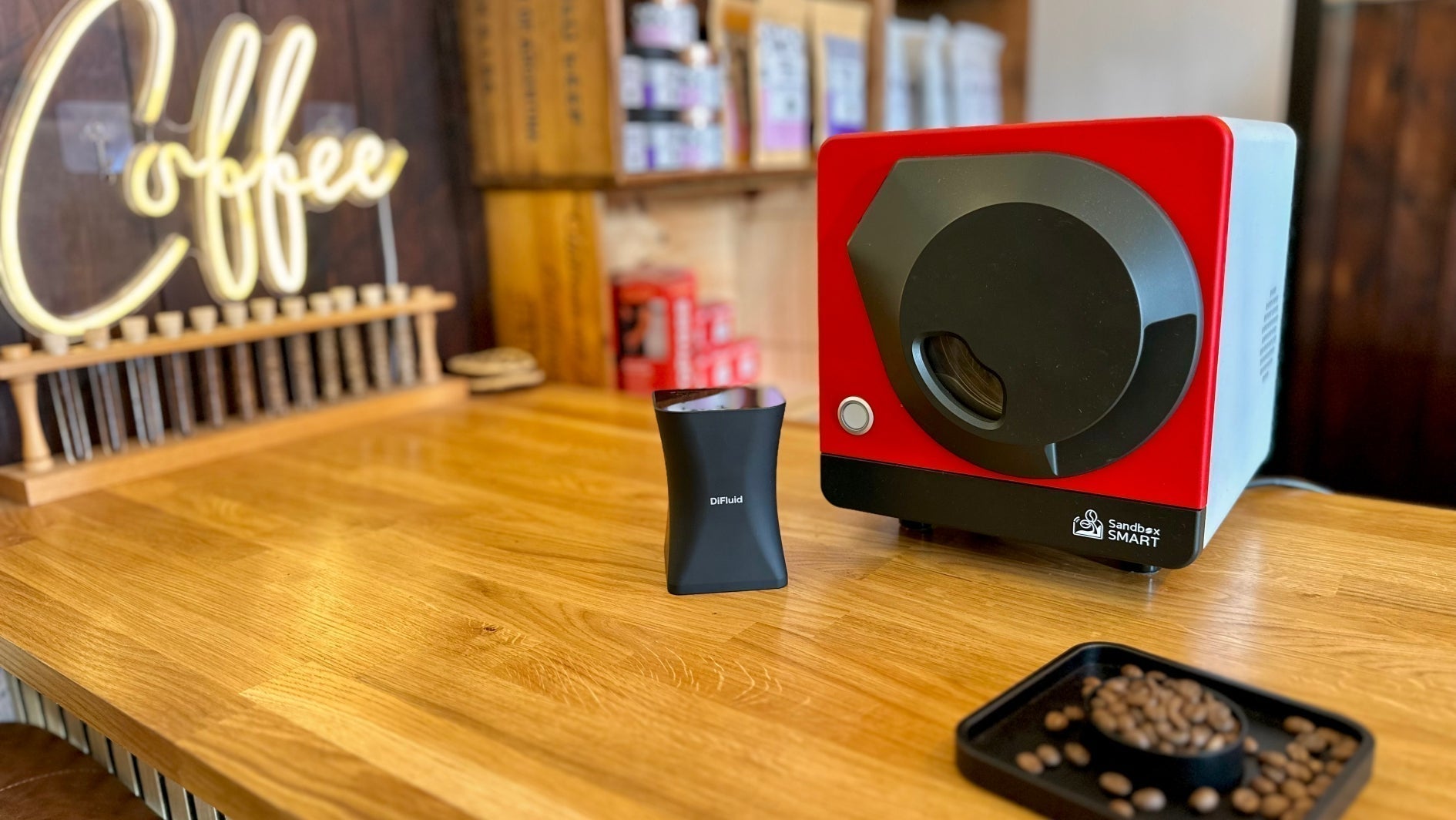
Another area where I felt we were lacking was experimentation. It is difficult to experiment with full production batches because consistency is always the priority, and there is always the risk of losing a batch if things go wrong. To help with that, we purchased a sample roaster. This allows us to experiment with our current coffees in smaller quantities, while also helping us prepare more thoroughly for new arrivals.
Whilst these may seem like small additions, they are important steps in improving both the quality and consistency of our coffees. Reinvesting in the business in this way helps us keep learning, keep improving, and once we find something working well, keeps it more consistent too.
What does coffee roasting consistency actually mean?
Consistency is generally split into two areas: in-batch consistency and inter-batch consistency, and both are equally important.
Inter-batch consistency is about roasting a particular coffee in a similar way each time, so that it develops as intended from one batch to the next. This helps ensure that every time you buy that coffee, it tastes broadly as expected.
In-batch consistency is about making sure that the coffee within a single batch is roasted evenly, so that once you have bought a bag, each brew you make from it tastes just as good as the last. This depends partly on the quality of the green coffee we buy, but it is also influenced by how we roast it.
For most of our customers, once they have found a coffee they really enjoy, they want to be able to enjoy it again. The difficulty is that coffee is still a natural product, so change is inevitable. It is not a perfectly uniform ingredient. That means our job as roasters is a balancing act. We need to maintain how a coffee tastes from batch to batch, while also recognising when we need to adjust our roasting to get the best out of it.
Why use a colour meter when roasting coffee?
Until recently, one of the main ways we tried to achieve consistency was by colour matching a batch to the previous one. The problem with this is that when coffee is hot, oils rise to the surface and give the beans more of a satin finish, which can make them appear darker than they really are. Once cooled, the coffee lightens slightly, and over time this meant our batches could gradually drift in colour. As colour, or development, is closely tied to flavour, that also meant flavour could shift over time too.
Our new colour meter from DiFluid gives us a way of measuring roast colour more accurately through the Agtron scale, which is an industry standard for judging how light or dark a coffee is. By testing every roast, we can spot much more quickly if batches are beginning to drift and make adjustments with the next batch.
We also test the colour of the coffee once it is ground. This helps us understand how developed* the inside of the bean is compared with the outside. That is important because a coffee can sometimes look correctly roasted on the surface, while the inside has not developed enough to bring out some of the compounds that contribute to flavour.
It is important to say that this is not a replacement for cupping and tasting, which is still the most important part of quality control. At the end of the day, flavour is what matters most. This is simply one more tool that helps us improve our consistency from batch to batch.

What does a sample roaster do?
A sample roaster is simply a small roaster that allows us to experiment and roast in very small quantities. That is helpful on a number of levels, as it gives us the freedom to test things without the risks that come with larger production roasts.
Most roasteries use sample roasters to help profile new coffees before scaling them up to full production. Being able to experiment with our new sample roaster has already been particularly valuable for our Limited Edition coffees. As these are coffees that do not stay year-round, it allows us to try different roast levels and taste them side by side before moving onto the production roaster.
With a new production roaster arriving later this year, we will be able to carry that experimentation into larger batches with much more confidence. Both the sample roaster and the production roaster allow us to track detailed roast profiles, including temperature curves and rate of rise. That means we can take what we learn on the sample roaster and apply it more accurately at scale.
For our customers, that should mean better consistency and a better understanding of how to get the best out of each coffee before it ever reaches the shelf.
What this means for the coffee in your cup
For us, all of this comes back to one thing: making sure the coffee in your cup is as good as it can be. The sample roaster gives us the freedom to experiment and better understand each coffee before we roast it in larger batches. The colour meter then helps us keep a closer eye on consistency once that coffee moves into production.
None of this replaces tasting, instinct or experience, but it does give us better tools to support them. Ultimately, it means more confidence in the coffees we release and a better chance of you enjoying them just as they were intended.
From a personal perspective, a big part of this is the discovery and learning that comes with it. I enjoy being able to experiment and learn as I go, and having data behind that process has given me a much clearer insight into how our coffees and roasting behave. That is one of the things I love most about the industry. Coffee can never be fully “completed”. It is a journey. These tools not only give us a better understanding of the coffees we roast, but also help us provide higher quality, more consistent coffee to our customers.
If you would like to taste the results for yourself, you can browse our current coffees here.
*Development is a roaster’s term which refers to the final stage of roasting, from first crack, where the beans literally ‘pop’ like popcorn, to cooling, and this is where a myriad of chemical processes take place and which determine the final taste of the coffee, depending on the length of time the beans are roasted and at what temperature etc.
Share:
Five Years, Five Lessons